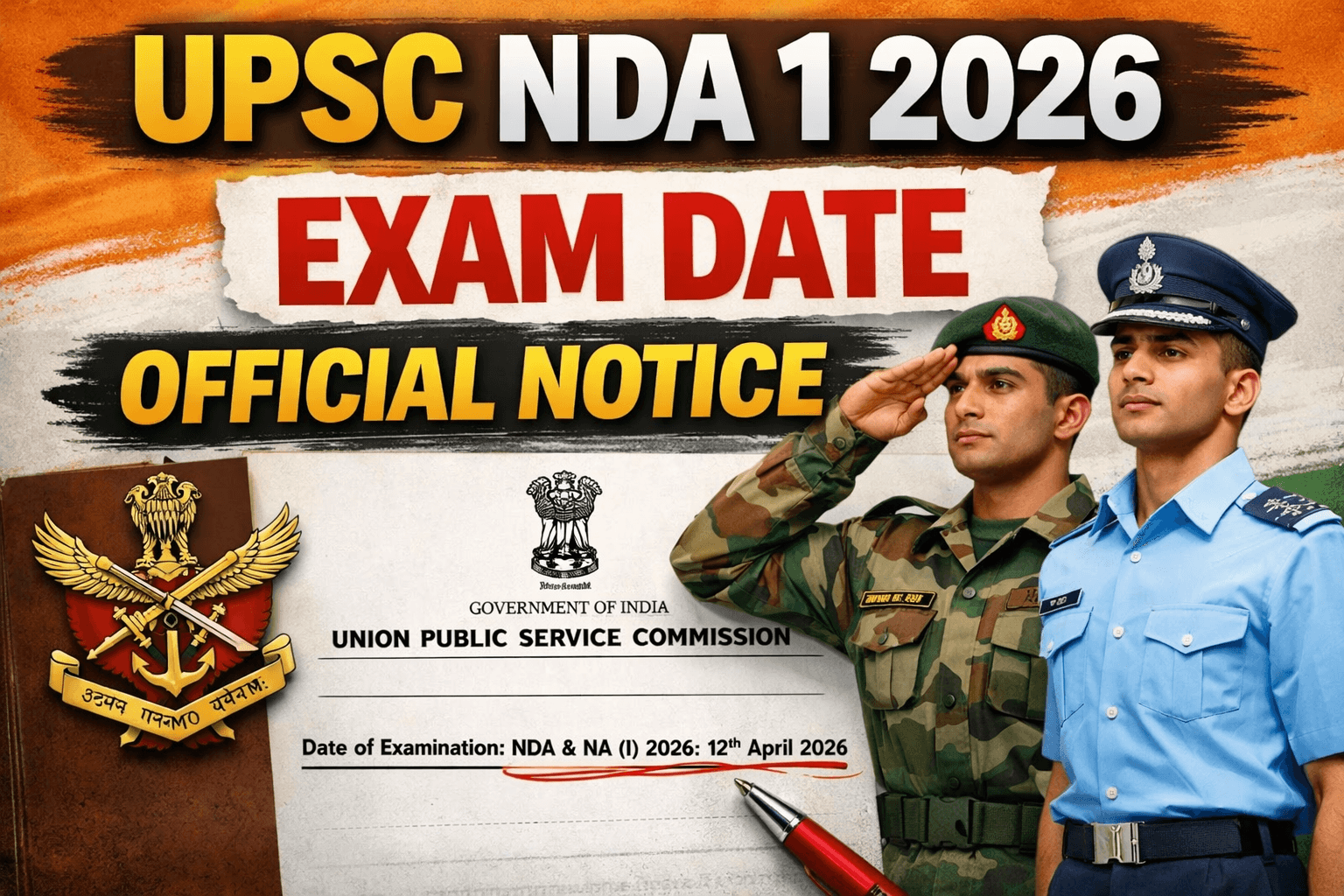
UPSC NDA 1 2026 is the first National Defence Academy and Naval Academy exam conducted by the Union Public Service Commission (UPSC) this year. The official notification was released on December 10, 2025, announcing the exam for aspiring candidates seeking entry into the Indian Armed Forces.
Key Dates
The NDA 1 2026 exam is scheduled for April 12, 2026 (Sunday), in offline mode across India.
Applications opened on December 10, 2025, with the last date to apply being December 30, 2025, followed by a correction window until early January 2026.
Admit cards are expected around April 2, 2026, and results are expected in May 2026.
Exam Overview
It targets 394 vacancies for unmarried male and female candidates eligible for the Army, Navy, and Air Force wings.
The selection involves a written test (Mathematics: 300 marks, GAT: 600 marks over 5 hours) followed by SSB interviews.
Check upsc.gov.in for the official PDF, eligibility (12th pass/appearing), and syllabus details.
NDA 1 2026 application form: How to apply for fees
NDA 1 2026 application forms were available online via upsconline.nic.in until December 30, 2025, now closed as of February 2026. Candidates needed to complete a two-part process: registration with basic details and uploading documents with fee payment.
How to Apply
The process started by visiting upsc.gov.in or upsconline. nic. in. Clicking “Online Application” and filling Part 1 (name, DOB, category) followed by Part 2 (photo, signature, exam center selection).
Scanned images required: photo (20-300 KB JPG, white background), signature (blue/black ink), and photo ID proof (PDF).
A correction window was available briefly after submission.
Application Fees
General/OBC/EWS candidates paid ₹100 online via debit/credit card, net banking, UPI, or SBI challan.
SC/ST, female candidates, wards of JCOs/NCOs/ORs, and PwD were exempted from fees.
Payment receipts were mandatory for reference during verification.The 2026 exam is scheduled for April 12, 2026 (Sunday), in offline mode across India. Applications opened on December 10, 2025, with the last date to apply being December 30, 2025, followed by a correction window until early January 2026. Admit cards are expected around April 2, 2026, and results are expected in May 2026.
Exam Overview
It targets 394 vacancies for unmarried male and female candidates eligible for the Army, Navy, and Air Force wings. The selection involves a written test (Mathematics: 300 marks, GAT: 600 marks over 5 hours) followed by SSB interviews. Check upsc.gov.in for the official PDF, eligibility (12th pass/appearing), and syllabus details. Follow-ups NDA 1 2026 eligibility criteria age limit, education,n NDA 1 2026 application form, how to apply, fees, NDA 1 2026 syllabus, detailed mathematics, GAT NDA 1 2026 exam pattern, marking scheme, negative NDA 1 2026 selection process, SSB interview after written.NDA 1 2026 eligibility requires unmarried male and female candidates aged 16.5 to 19.5 years, specifically born between July 2, 2007, and July 1, 2010 (both dates inclusive). No age relaxation applies to any category.
Educational Qualifications
For the Army Wing, candidates need to have passed or be appearing in Class 12 from a recognized board.
Air Force and Naval Wings require Class 12 with Physics, Chemistry, and Mathematics (PCM).
Additional criteria include Indian nationality (or specified equivalents) and meeting physical/medical standards detailed in the official notification.
Other Requirements
Candidates must be physically fit per UPSC standards, with no prior marriage.
Unlimited attempts are allowed within the age limit.
NDA 1 2026 exam syllabus and pattern
NDA 1 2026 follows the standard UPSC exam pattern with two objective papers totaling 900 marks over 5 hours, conducted offline. Mathematics (Paper 1) carries 300 marks (120 questions, 2.5 marks each), while GAT (Paper 2) has 600 marks, split into English (200 marks) and General Knowledge (400 marks).
Exam Pattern
Mathematics: 2.5 hours; covers Class 11-12 topics; negative marking of 1/3rd (0.83 marks) per wrong answer.
GAT: 2.5 hours; English focuses on grammar/vocabulary; GK spans Physics (~25%), Chemistry (~15%), General Science, History, Geography, Current Affairs (~20-25% each).
Total questions: ~150 (Maths 120, GAT ~150, varying by sub-section); no sectional timing.
Syllabus Highlights
Mathematics: Algebra (matrices, determinants), Trigonometry, Analytical Geometry (2D/3D), Differential/Integral Calculus, Vectors, Statistics & Probability.
English: Grammar, synonyms/antonyms, comprehension, vocabulary.
GK: Physics (mechanics, optics), Chemistry (atomic structure), Biology basics, Indian History/Freedom Struggle, Geography, Current Events.
NDA 1 2026 preparation strategy and timetable
NDA 1 2026 preparation demands 6-8 hours daily of focused study, balancing Maths, GAT, current affairs, revision, and physical fitness, given the exam on April 12, 2026. Prioritize NCERT books (Class 9-12), previous year questions (PYQs), and weekly mocks while tracking errors in a dedicated notebook.
Daily Timetable
Follow a structured routine like this (adapt as needed):
| Time | Activity |
|---|---|
| 5:30-6:30 AM | Wake up, exercise/jogging |
| 6:30-8:00 AM | Maths practice (NCERT + problems) |
| 8:00-9:00 AM | Breakfast + current affairs |
| 9:00-11:00 AM | GAT/English (grammar, vocab, GK) |
| 11:00-12:00 PM | Revision/formulas |
| Afternoon | Lunch + rest/physical training |
| 4:00-6:00 PM | Mock test/sectional practice |
| 6:00-8:00 PM | Weak topics + analysis |
| Evening | Dinner, light reading, sleep by 10 PM |
Phase-wise Strategy
Months 1-2 (Foundation): Build basics with NCERT Maths/Science, English grammar, GK NCERTs; daily 10 vocab words, 30 min current affairs.
Months 3-4 (Practice): PYQs, 30-50 problems/topic, weekly mocks; focus on high-weightage areas like algebra, physics.
Last 1-2 Months (Revision): Daily full mocks (8-10 total), error book review, speed drills; include SSB awareness.
Key Tips
Solve 20+ sectional tests and 10+ full mocks; maintain fitness (70/90 days streak) and 7 hours of sleep. Use resources like Pathfinder for practice; stay consistent without coaching if disciplined.
Common mistakes to avoid in NDA exam preparation
Common mistakes in NDA exam preparation often stem from poor planning and neglecting key habits, leading to suboptimal performance despite hard work.
Top Mistakes to Avoid
Skipping mock tests and PYQs, which fail to build exam stamina, time management, and error analysis.
Ignoring NCERT basics (Class 9-12), jumping straight to advanced books, causing weak conceptual clarity.
No structured study plan or timetable, resulting in uneven coverage, burnout, and ignored weak areas.
Strategy Errors
Over-relying on coaching without self-study; neglecting GAT/English, current affairs, or physical fitness/SSB prep.
Poor time management in mocks (e.g., lingering on tough questions) or during the exam itself.
Following myths, overconfidence, or ignoring feedback from practice tests.
Quick Fixes
Prioritize daily mocks (2-3/week), error logs, NCERTs first, balanced routine (6-8 hrs study + fitness), and consistent revision of high-weightage topics like algebra and physics.
NDA exam day time management strategies and tips
NDA exam day time management is crucial for the 5-hour duration, with 2.5 hours each for Mathematics (120 questions) and GAT (150 questions), emphasizing speed, accuracy, and strategic skipping.
Pre-Exam Practice
Practice timed mock tests regularly (2-3 weekly) to simulate conditions, aiming for 1-1.5 minutes per question in Maths and under 1 minute initially in GAT.
Learn shortcuts like Vedic Maths for calculations and use elimination for MCQs to cut decision time.
During Exam Strategy
First Pass: Scan and answer easy/confident questions first to secure marks quickly (easy Maths first, then GAT English/GK short-answer ones).
Time Allocation: Maths ~1.5 min/question; GAT divide into English (quick grammar/vocab) then GK sub-sections; flag tough ones for later.
Clock Check: Glance every 20-30 minutes; if stuck >2 mins, skip and mark; use final 15-20 mins for review/guesses (no negative for blanks, but avoid wild guesses).
Additional Tips
Carry a watch; stay calm with deep breaths if panicked; prioritize accuracy over speed to minimize 1/3 negative marking.
Arrive early, read instructions fully, and bubble the OMR sheet in batches to avoid last-minute rushes.
Official websites for UPSC NDA 1 2026 provide notifications, applications, and updates directly from the source.
Key Websites
| Purpose | Website | Details |
|---|---|---|
| Main UPSC Portal | upsc.gov.in | Notifications, exam calendar, results, official PDFs. |
| Online Applications | upsconline.nic.in | OTR registration, form filling (now closed for NDA 1 2026). |
| Exam-Specific Page | upsc.gov.in/examinations/National%20Defence%20Academy%20and%20Naval%20Academy%20Examination%20(I),%202026 | NDA 1 2026 notification dated Dec 10, 2025. |
NDA 1 2026 FAQs
Here are key questions and answers on UPSC NDA 1 2026 based on the official notification and details shared earlier.
Q: What is the exam date for NDA 1 2026?
A: April 12, 2026 (Sunday), conducted offline across India.
Q: How many vacancies are announced?
A: 394 for Army, Navy, and Air Force wings (unmarried male and female candidates).
Q: What is the age limit?
A: 16.5 to 19.5 years; born between July 2, 2007, and July 1, 2010 (inclusive).
Q: What are the educational qualifications?
A: Army Wing: Class 12 pass or appearing; Air Force/Navy Wings: Class 12 with Physics, Chemistry, and Mathematics.
Q: When was the application window?
A: Opened December 10, 2025; closed December 30, 2025; correction window in early January 2026.
Q: What is the application fee?
A: ₹100 for General/OBC/EWS (exempt for SC/ST, females, and certain categories); paid online or via SBI challan.
Q: What is the exam pattern?
A: Two papers – Mathematics (300 marks, 120 questions, 2.5 hours); GAT (600 marks, 150 questions, 2.5 hours); 1/3rd negative marking.
Q: What does the syllabus cover?
A: Maths: Algebra, Trigonometry, Calculus, etc.; GAT: English (grammar, vocab), GK (Physics, History, Current Affairs, etc.).
Q: When are admit cards released?
A: Expected around April 2, 2026, on upsc.gov.in.
Q: What is the selection process?
A: Written exam (900 marks) followed by SSB interview; final merit based on a total of 1800 marks.